

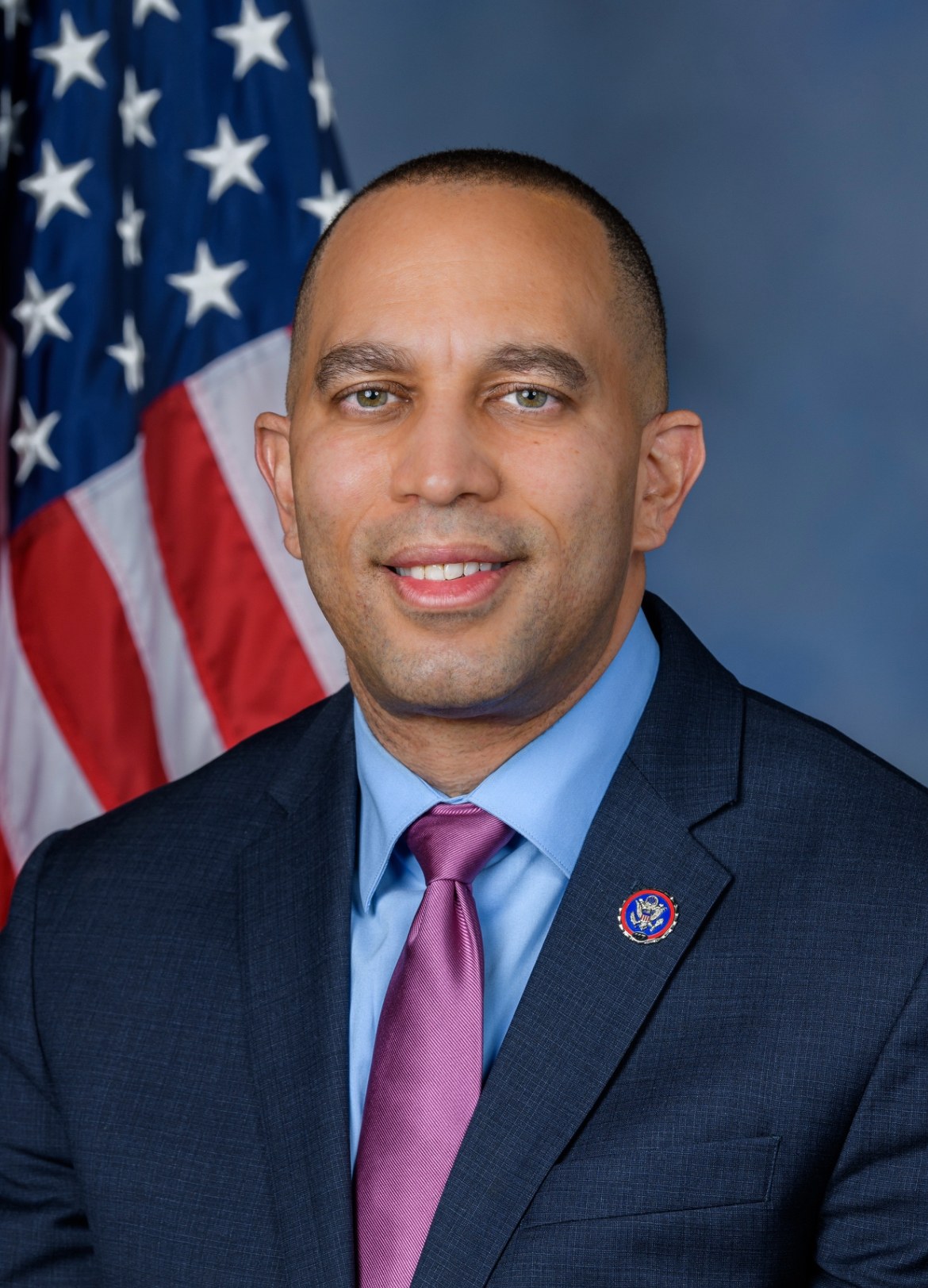
WASHINGTON — Democrats elected this month to the House of Representatives nominated Hakeem Jeffries on Wednesday to lead them in the next Congress, putting him on the precipice of becoming the nation’s first Black speaker of the House. The incoming House Democratic Caucus chose Jeffries in a closed-door, secret-ballot vote, 251 to 11. He ran uncontested. The vote kickstarts the formal selection process: the full House elects its speaker on the floor when the new Congress convenes on January 3, and a candidate needs 218 votes. Democrats will have a majority of at least 257 seats. The speaker is second in line to the presidency. Jeffries, 56, from Brooklyn, has led House Democrats since 2023, and he led the party through a midterm election this month in which it flipped more than 40 Republican districts. House Republicans last week nominated Judiciary Committee chairman Jim Jordan to lead their conference, and Jordan is expected to be the Republican candidate opposite Jeffries in January.
The job he is one vote from taking is the most powerful in Congress. The speaker sets the House’s agenda, decides which bills reach the floor, appoints the members of its committees and stands second in the line of presidential succession, behind only the vice president. A Jeffries speakership, paired with a Democratic Senate, would put both chambers of Congress in the hands of the opposition party for the final two years of Mr Trump’s term — the governing reality that the midterm results created and that Wednesday’s ballot began to organise. Jeffries has led the House Democrats through two years in the minority, a period in which his caucus’s discipline was his calling card: on vote after vote his members held together while the majority’s margins shrank. The midterms converted that discipline into a majority of at least 257 seats. Wednesday’s vote was the first formal step in converting the majority into a government.
A Ballot He Asked For
The nomination did not have to look like this. Jeffries could have been nominated by acclamation, with no ballots cast and no count taken. On Tuesday he changed course, telling reporters he wanted a counted vote, following the approach Democrats took in 2018, the last time they won back the House. The count, when it came, was emphatic but not unanimous: 251 for Jeffries, 11 against, in a secret ballot whose individual votes are not public. Many incoming progressives had declined to say in advance whether they would back him, and the 11 no votes are the measure of the dissent he carries into January — real, but nowhere near the number that could threaten him on the floor, where his party’s cushion above the 218 line is roughly forty seats. The room, by the accounts of those inside, rang with applause when the result was announced. Jeffries is now, formally, a nominee. He is not yet speaker: that title waits on the roll call of the whole House, members of both parties voting, on the first day of the new Congress.
The Senate Is Settled, Too
The House vote landed the morning after the midterm map was finally completed. On Tuesday night the Associated Press called the last uncalled Senate race in the country, in Alaska, for Democrat Mary Peltola, who defeated the two-term Republican incumbent, Dan Sullivan. The Alaska Division of Elections published a summary with all 401 precincts reporting: Peltola took 144,302 votes, 50.12 per cent of first-choice votes, to Sullivan’s 131,844 and 45.80 per cent, from 290,003 ballots cast by 605,433 registered voters, a turnout of 47.90 per cent. Because she cleared 50 per cent on the first count, Alaska’s ranked-choice system requires no further rounds. Her win is the ninth Senate seat Democrats flipped in these midterms, and it fixes the new Senate at 56–44 — the party’s largest Senate majority since 2009, and, with the House also won, two years of divided government facing President Trump. Peltola, 53, who worked in commercial fishing before politics and previously held Alaska’s lone House seat, is the first Alaska Native elected to the Senate from the state and the first Democrat to win one of its Senate seats in nearly twenty years; she is only the fifth Democrat since statehood to represent Alaska there. “It’s official: 56 Democratic Senate seats,” Chuck Schumer wrote. In North Carolina, Democrat Raymond Smith also took a House seat from Republican Greg Murphy as the final counts settled.
The Cloud Over Alaska
One part of the Alaska result is still being fought. In late October the Justice Department sued to stop Alaska certifying the result if Sullivan lost; a federal judge dismissed the lawsuit, and the department has appealed. The department has also confirmed a criminal investigation connected to a third candidate on the ballot, Dan J. Sullivan, after a New York Times report that members of Peltola’s campaign helped recruit him — a candidate sharing the incumbent’s surname, who took about 2.5 per cent of the vote. Those are allegations and an investigation, not findings, and Peltola’s margin does not depend on them: she beat the incumbent by more than twelve thousand votes and cleared the outright-majority threshold with votes to spare. State officials are targeting November 25 to certify the result, with the department’s appeal to be decided against that calendar. None of it changes the arithmetic Jeffries woke up to on Wednesday: both chambers of the next Congress will be led by Democrats, the Senate by a 56–44 margin, and the House — if January 3 goes the way Wednesday’s ballot says it will — by the first Black speaker in its history.
Sources: Reuters, “Democrats nominate Hakeem Jeffries for next US House speaker,” November 18, 2026; The Associated Press via NPR, “Democrats formally nominate Hakeem Jeffries for speaker of the House,” November 18, 2026; USA Today, November 18, 2026; Reuters and the Associated Press on the Alaska Senate call, November 17–18, 2026; Alaska Division of Elections results summary via FairVote, November 17, 2026.

Comments