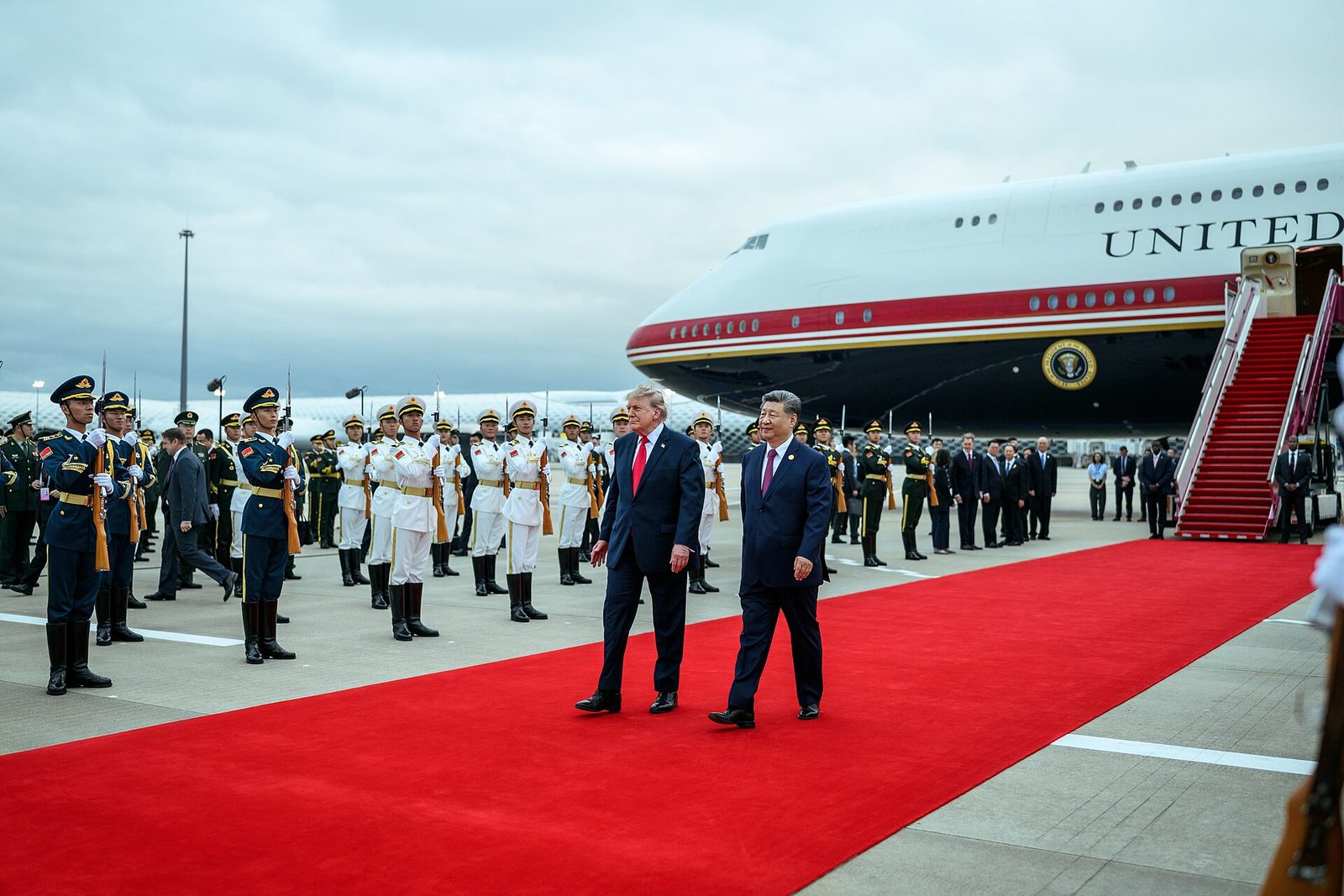
President Donald Trump, President Xi Jinping and President Vladimir Putin ended the first meeting of the American, Chinese and Russian leaders ever held on Thursday by issuing a joint statement the three called a “peace declaration” — a four-point document covering reform of the United Nations, the supply of refined oil, the immunity of state officials and nuclear weapons. The statement was released by China’s Xinhua news agency and by the Kremlin after talks at Kylin Villa in Shenzhen.
Xi hosted the meeting at Kylin Villa, a state residence beside a lake in the southern Chinese city, on the sidelines of the Asia-Pacific Economic Cooperation leaders’ summit. The talks began in the late afternoon local time; China’s CCTV and Russia’s Tass news agency said they lasted about an hour and a half, while other accounts put the session closer to 80 minutes. None of the three made a statement afterward. Trump left for the airport immediately after the session and flew back to the United States; he is scheduled to hold a news conference at the White House on Friday.
What The Declaration Says
The first point commits the three countries, “as permanent members of the United Nations Security Council”, to reform the UN “so that the UN can respond more effectively to global challenges and conform to its fundamental mission of international peace and security”. In the second, the three “plan to increase the production and supply of refined petroleum products for the benefit of all nations”, and reaffirmed the importance of stable energy flows.
The third point addresses international courts. The three heads of state, the text says, “recognised that the principle of state consent and respect for immunities of State officials are of paramount importance”, and concurred that “the International Criminal Court and similar institutions must not abuse their jurisdiction”. An arrest warrant issued by the ICC for Putin in 2023, over Russia’s invasion of Ukraine, remains in force.
The fourth point is the nuclear one. The three leaders “reaffirmed that a nuclear war cannot be won and must never be fought”, and said their countries “will conduct a dialogue on reducing nuclear risks and preventing the proliferation of nuclear weapons”. The dialogue has no announced timetable and no announced format, and the declaration sets no limits on any country’s stockpile.
What the document does not contain is as specific as what it does. The published points do not mention Ukraine, Iran, Taiwan or trade. There are no ceasefire proposals, no territorial settlements and no binding arms reductions or deadlines. A separate APEC statement released as the talks concluded was limited to pledges and aspirations about cooperating on trade, technology innovation and economic growth.
What Was Expected — And What Came Out
US officials had said no agreement was expected, and the White House initially indicated Ukraine would not be on the formal agenda without President Volodymyr Zelensky of Ukraine present, though Trump subsequently said he would raise the conflict. The stated American aim was narrower: White House spokeswoman Olivia Wales said Trump would discuss reducing nuclear weapons. On substance, what emerged matched those expectations — a pledge to talk about nuclear risk, and no agreement on either of the two wars.
France’s President Emmanuel Macron said the declaration would not “lead to a reorganisation of the world”. The gathering was described in some circles as a “Yalta 2.0”, after the 1945 meeting that divided postwar Europe. The BBC’s North America correspondent wrote that the event was more a stage for displaying the balance of power among three great powers than as a forum for policy breakthroughs.
What The Three Leaders Said
Xi called the first meeting of the three heads of state one of “groundbreaking significance”. He set out four principles — mutual respect, peaceful coexistence, mutually beneficial cooperation and dialogue — and said: “Constructive cooperation among them is not a matter of choice, but an absolute necessity.” He described nuclear weapons as a “sword of Damocles” hanging over humanity, and spoke of a world free of nuclear weapons as the long-term goal.
Trump told his counterparts that “we are really making history”, and said the three countries were uniquely positioned to discuss reducing nuclear weapons and lowering the risk of their use. “No peace was ever forged by declining opportunities for engagement,” he said. In his earlier one-to-one meeting with Putin, Trump pointed at the Russian president and called him “my friend”. In his talks with Xi, Trump said Washington and Beijing both wanted energy to keep flowing through the Strait of Hormuz, and the two agreed that Iran must not obtain a nuclear weapon.
Putin described the three countries as victors of the Second World War that share responsibility for global peace, and said Russia, the United States and China had a shared interest in resolving the conflict in Ukraine. The Kremlin said the atmosphere at the meeting was “good”.
The Road To Kylin Villa
The idea of a three-way meeting was first raised publicly in September, after a phone call between Trump and Putin, according to Kremlin spokesman Dmitry Peskov. Trump said on October 19 that he would be willing, China’s Foreign Ministry confirmed in early November that it was “in communication with relevant parties”, and on November 14 the White House announced the meeting for November 19.
On Wednesday, Trump and Putin met informally in Shenzhen, and Putin also met Xi. On Thursday, after the APEC plenary session, Trump held separate talks with Putin — a pull-aside of less than an hour — and then with Xi, before the three-way session began. The delegations included the two foreign ministers, Sergey Lavrov and Wang Yi.
The Nuclear Backdrop
The nuclear pledge is the first trilateral commitment of its kind. It comes nine months after the expiry, on February 5, of New START, the last treaty limiting deployed American and Russian strategic nuclear arms, left the two largest nuclear powers without a binding cap. China has long said its much smaller arsenal should not be limited on equal terms; SIPRI estimates put China’s stockpile at 620 warheads in January.
Zelensky said in October that the three powers were free to meet, but that Ukraine must take part in any talks on its own future. The Group of 20 summit in Miami in December is expected to bring Trump and Xi together again; Putin has been invited, and the Kremlin has linked his decision to the results of the Shenzhen talks. The US–China trade truce expires on January 10, 2027.
Sources: BBC News, November 19, 2026; Reuters, November 19, 2026; The Times, November 19, 2026; Xinhua, November 19, 2026; USA Today, November 19, 2026; Qazinform, November 19, 2026; The White House, November 19, 2026.

Comments