
American fighter jets struck an Islamic Revolutionary Guard Corps missile launch site on Qeshm Island in the Strait of Hormuz on Tuesday, US officials said, after Iranian combat drones targeted a US-operated radar system at Sheikh Isa Air Base in Bahrain. The exchanges continued into Wednesday, with Bahrain intercepting a further round of Iranian aerial attacks and Kuwait reporting hostile drones over its territory. It was the latest round of a war that has settled into strikes and counter-strikes around the strait, fought even as mediators work to end it.
The Drone Attack On The Bahrain Radar
The Revolutionary Guards said their combat drones had carried out a “precision operation” against the US-operated radar system at Sheikh Isa Air Base. The Guards said the attack answered repeated violations of Iranian airspace by American drones.
Bahrain gave a different account of the result. The kingdom said its air defences confronted, intercepted and destroyed the attacks before they reached their targets. The US military said the drones were intercepted, with no damage to US equipment and no injuries.
Bahrain hosts the headquarters of the US Navy’s Fifth Fleet, and Sheikh Isa is one of the bases from which American forces operate across the Gulf. The radar there watches the airspace over the northern Gulf and the approaches to the Strait of Hormuz.
The Guards framed the drone attack as an answer to American flights over Iran itself: in their account, US drones had repeatedly violated Iranian airspace, and the radar at Sheikh Isa was the target they chose in reply. Washington’s statement dealt only with the result: drones intercepted, nothing damaged, nobody hurt.
The Strike On Qeshm
US officials said American fighter jets then struck the Guards’ missile launch site on Qeshm Island, in the strait, and described the strike as self-defence — a direct answer to the drone attack on the radar in Bahrain.
Iran’s account came from the province. IRNA, the state news agency, citing the deputy governor of Hormozgan, said five to six explosions were heard on Qeshm, and that there was no damage to residential, commercial or infrastructure areas on the island. The deputy governor’s account dealt with what the explosions did not hit; Iran has not published its own assessment of what they did.
Qeshm Island sits on the Iranian side of the Strait of Hormuz, the narrow waterway between the Gulf and the Gulf of Oman through which the region’s oil and gas exports pass to the world. A missile site there overlooks the shipping lanes at the strait’s mouth.
A launch site on Qeshm can fire across the strait in minutes. The island sits at the narrowest part of the waterway, where the shipping lanes pass between Iran and Oman, and missiles placed there range both the lanes themselves and the Gulf states on the far shore.
The Revolutionary Guards also claimed that they had intercepted and captured a US drone south of Qeshm. The claim was carried by Iranian outlets. It has not been verified, and US officials did not confirm it.
A Third Attack On Bahrain In Under A Week
The exchanges did not end on Tuesday. In the early hours of Wednesday, Bahrain’s defence force said it had intercepted a further round of Iranian aerial attacks, as sirens sounded across the kingdom. The sirens were the sound Bahrain has heard three times in six days.
It was the third Iranian attack on Bahrain in under a week. The earlier attacks came on Friday, and on Sunday, when six drones were sent against a US radar at Riffa airbase. Wednesday morning’s interception made three rounds of Iranian fire at the kingdom in six days.
The bases are the fixed points of the American position in the Gulf: the Fifth Fleet’s headquarters in Bahrain, the radar sites at Sheikh Isa and Riffa, and Ali Al-Salem in Kuwait. Each round of this exchange has been aimed at one or more of them.
Kuwait was drawn in on Wednesday as well. Kuwait’s military said its air defences were countering hostile drones. Iran’s army said its drones had targeted Patriot air defence systems and drone and missile launch platforms at Ali Al-Salem Air Base in Kuwait, a base that hosts US forces.
Carriers, Talks And The Oil Price
The fighting continued despite talks between Iran and the mediators Oman and Qatar, the two Gulf states that have carried messages between Tehran and Washington through the war. The talks have not produced a pause in the fighting.
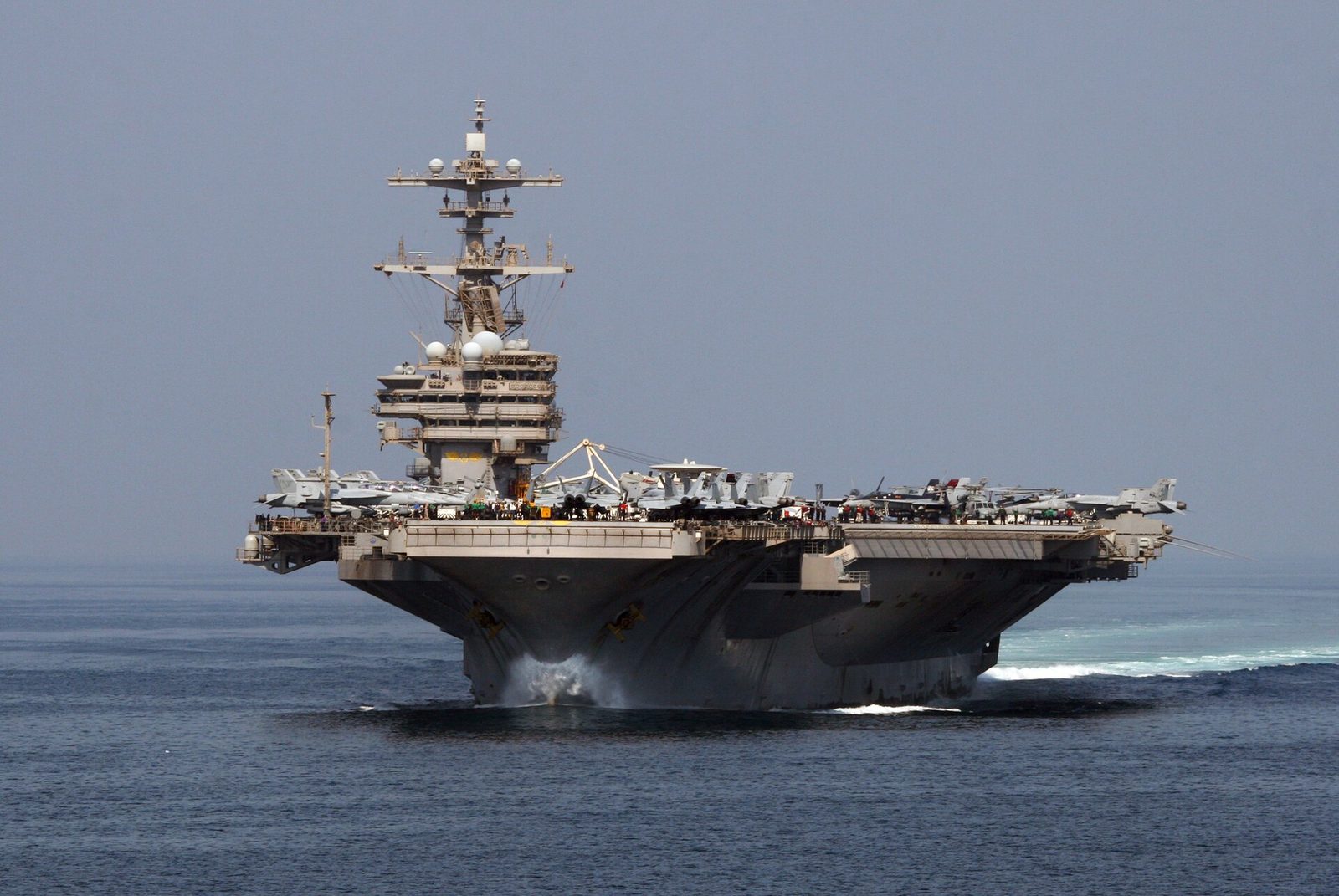
American naval power in the region has been built up as the exchanges have gone on. Three US carrier strike groups are now in the region — the Theodore Roosevelt has joined the George H.W. Bush and the George Washington — together with more than a dozen destroyers.
The three carrier groups put three flight decks within range of Iran at once, a concentration the United States has maintained as the exchanges around the strait have intensified this month.
Oil markets, for now, looked past the exchange. Brent crude fell below $92 a barrel, with January Brent at $91.49 at 08:59 UTC on Wednesday, down 1.77 per cent, after a build in US crude stocks.
Taken together, the two days describe the war’s current shape in the Gulf: Iran striking at the American bases that ring the strait, the United States striking back at the launch sites on its coast, the Gulf states intercepting what is aimed at them, and the mediators in Muscat and Doha working a channel that neither side has closed.
Iran is also on Thursday’s agenda in Shenzhen, where Xi Jinping hosts Donald Trump and Vladimir Putin for the first China–Russia–US leaders’ meeting; US officials say the agenda includes nuclear arms reductions and Iran.
The US–Iran war began on February 28, and Tuesday was its 264th day. The pattern around the strait is now established: Iranian drones against American bases in the Gulf states, American jets against the launch sites on the Iranian coast and islands, and a mediation track that has not stopped either. On Wednesday morning, with sirens in Manama and drones over Kuwait, it ran on.
Sources: Reuters, November 17–18, 2026; Associated Press, November 17–18, 2026; AFP, November 17–18, 2026; Al Jazeera, November 17–18, 2026; US officials, statements reported November 17–18, 2026; IRNA, November 17, 2026.
Comments